A successful corporate event is far more than a simple calendar entry. It serves as a vital business and marketing strategy that enhances organizational recognition, promotes meaningful connections, and ensures all stakeholders remain in harmony while gaining market traction.
From global conferences and investor meetings to product launches and leadership retreats, a well-executed event can drive revenue, strengthen internal culture, and build long-term partnerships. On the other hand, poorly managed events can lead to significant financial waste and operational instability.
This is why corporate event management must be treated as a disciplined business function rather than a secondary task for an overloaded team.
In this blog, we explore the comprehensive framework of modern corporate event management.
We cover essential areas such as event strategy, logistics control, and budgeting structures, along with proven management tips designed to protect both your brand and your bottom line.
What Is Corporate Event Management?
Corporate event management is the structured process of planning, coordinating, and executing business-focused events designed to achieve measurable outcomes.
Unlike social event planning, professional event planning for companies requires operational precision, financial oversight, vendor governance, compliance management, and cross-functional coordination.
Corporate events commonly include:
Industry conferences
Trade shows and exhibitions
Product launches
Shareholder meetings
Sales kickoffs
Leadership offsites
Client appreciation events
Hybrid and virtual events
Corporate Event Planning Framework
Every high-performing event starts with a clear corporate event strategy, because without strategic clarity, even the most polished production becomes an expensive exercise in corporate event logistics.
Before you choose a venue or brief vendors, align on the event’s purpose and how you’ll measure success.
A substantial corporate event strategy should answer:
What measurable outcome are we targeting?
Who is the core audience?
What business objective does this support?
How will success be quantified?
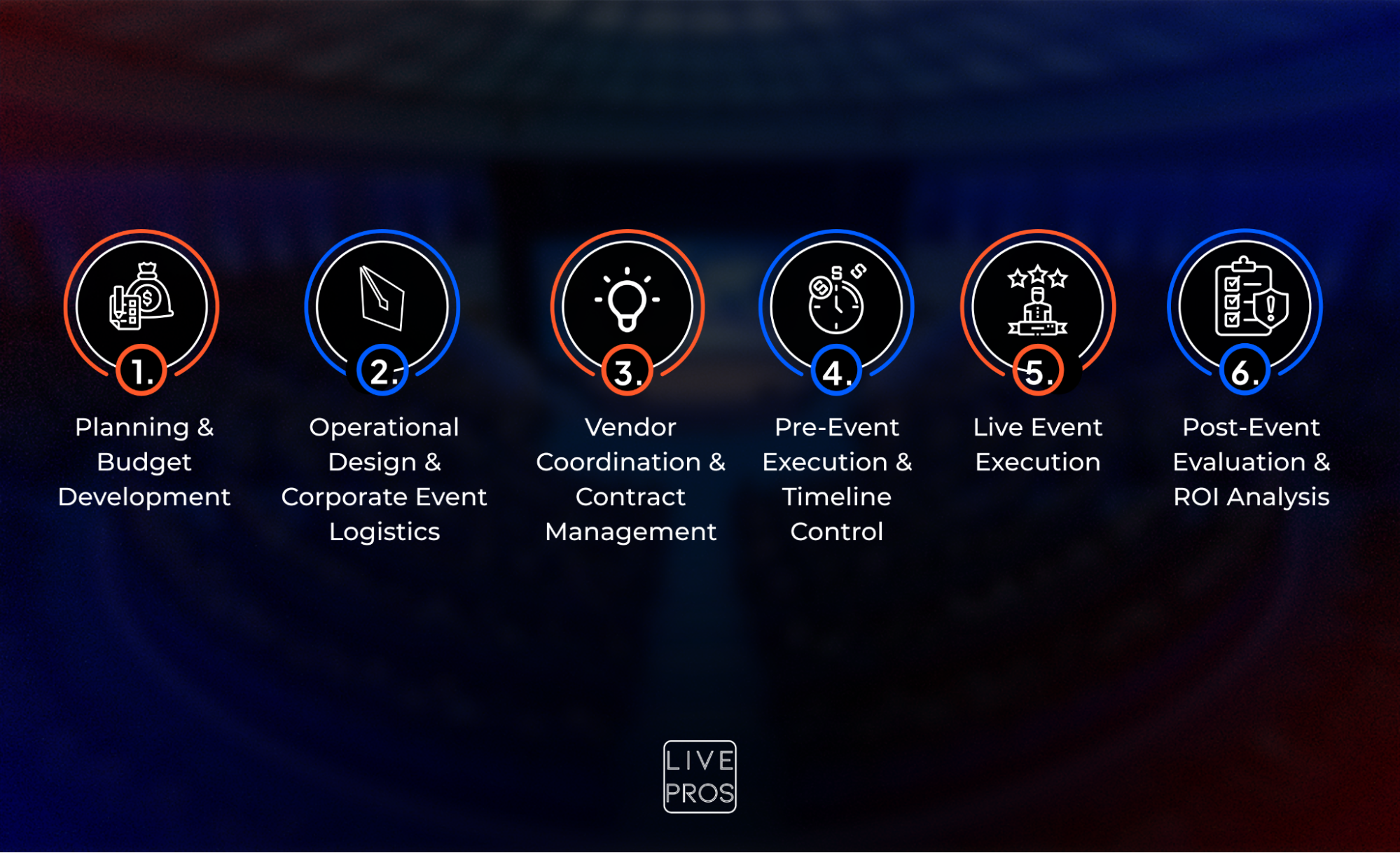
With that foundation in place, you can apply a structured lifecycle, the Corporate Event planning framework, to turn strategy into predictable execution. This approach reinforces corporate event planning best practices, reduces risk, and helps teams deliver consistent results through professional event planning.
The Corporate Event Planning Framework
Successful corporate events follow a structured lifecycle. Applying consistent corporate event planning best practices reduces risk and increases predictability.
1. Planning & Budget Development
This stage defines scope and feasibility.
It includes:
Objective setting
KPI development
Budget forecasting
Timeline mapping
Venue research
Vendor pre-selection
Strong budgeting is one of the most important business event management tips. It ensures realistic expectations and prevents mid-project scope expansion.
2. Operational Design & Corporate Event Logistics
This is where ideas become executable plans.
Corporate event logistics include:
Venue layout and capacity planning
Load-in and load-out schedules
Audio-visual production mapping
Guest registration systems
Transportation and access control
Security protocols
Technical rehearsals
Complex events require experienced corporate event organizer services to manage overlapping vendors and ensure seamless integration.
Logistics are rarely glamorous, but they are where events either succeed or fail.
3. Vendor Coordination & Contract Management
Corporate events often involve:
Production companies
Caterers
Entertainment providers
AV technicians
Decor specialists
Registration platforms
Professional corporate event organizer services manage contracts, payment milestones, insurance requirements, and service-level agreements.
One overlooked vendor can derail an entire event timeline. Applying disciplined corporate event planning best practices ensures accountability across all partners.
4. Pre-Event Execution & Timeline Control
As the event approaches, precision becomes critical.
This stage includes:
Finalizing event schedule
Confirming production run-of-show
Conducting rehearsals
Confirming staffing
Locking vendor arrivals
Testing technical systems
Effective timeline control is one of the most underestimated business event management tips. When schedules slip, budgets inflate.
5. Live Event Execution
On event day, strategy becomes performance.
Professional teams manage:
Guest experience flow
Stage transitions
Speaker support
Technical troubleshooting
Crisis response
This is where experienced corporate event organizer services prove their value. Real-time decision-making protects brand reputation.
Strong professional event planning for companies means executives can focus on messaging rather than operational fires.
Even experienced organizations make preventable errors. The most common include:
Underestimating production timelines
Failing to define measurable objectives
Ignoring contingency budgets
Overloading internal teams without operational support
Skipping post-event analysis and reporting
Applying consistent corporate event planning best practices reduces recurring mistakes and strengthens long-term event performance. Discipline and documentation are what separate repeatable success from reactive planning.
Planning a corporate event? Start with these proven business event management tips to keep your strategy aligned and execution under control.
Corporate Event Planning Best Practices That Deliver Results
Corporate event success is built on systems, not spontaneity. From logistics and financial governance to risk mitigation and technology integration, applying consistent corporate event planning best practices protects both brand and budget.
Managing Corporate Event Logistics
Most attendees never notice logistics unless something goes wrong. That’s the paradox. When corporate event logistics are executed properly, they are invisible. When they are not, they dominate the experience for all the wrong reasons.
Effective logistics management includes:
Capacity planning to ensure space aligns with attendance projections
Technical power and AV integration that supports presentations, streaming, and production demands
Crowd management and guest flow design to prevent congestion and confusion
Accessibility compliance to meet legal and inclusion standards
Risk mitigation protocols for safety and operational continuity
Contingency planning for weather, technical issues, or vendor disruptions
Applying disciplined corporate event planning best practices ensures that every moving part is mapped before execution. The goal is simple: operations should feel effortless, even when they are highly complex.
Budgeting & Financial Governance
Corporate budgets demand transparency, accountability, and control. Unlike social events, business events must justify investment and demonstrate measurable value.
Strong financial governance in corporate event planning includes:
Separating fixed and variable costs for clearer forecasting
Conducting detailed vendor cost comparisons before final selection
Allocating contingency reserves for unforeseen adjustments
Establishing clear approval workflows across departments
Maintaining ongoing financial tracking throughout the event lifecycle
One of the most overlooked business event management tips is continuous oversight. Budget control is not a one-time exercise during planning. It requires monitoring from the initial proposal through final invoice reconciliation.
Experienced corporate event organizer services often negotiate preferred vendor rates and identify inefficiencies early, protecting margins while maintaining production quality.
Risk Management
Every corporate event carries operational, financial, and reputational risk. The difference between a minor issue and a major failure is preparation.
Common vulnerabilities include:
Technical failures affecting presentations or live streaming
Security incidents involving guests or high-profile executives
Speaker cancellations or delays
Weather disruptions for outdoor programming
Data breaches in hybrid and digital environments
Vendor non-performance or service gaps
Proactive corporate event planning includes mapping contingencies for each risk category. Backup vendors, alternative schedules, insurance coverage, and emergency protocols are not optional. They are standard operating procedures in professional event planning for companies.
Strong risk control protects not only the event but the organization’s brand and credibility.
Use of Latest Technology
Technology has reshaped corporate event planning, making it more measurable, scalable, and data-driven.
Modern corporate events rely on:
Integrated event management platforms for centralized control
Advanced registration software for tracking and communication
CRM integration to align event data with sales pipelines
Hybrid streaming platforms for global accessibility
Real-time engagement analytics tools to measure participation
Technology is not simply a convenience. It strengthens corporate event strategy by converting live experiences into measurable business intelligence. Data collected during events informs future marketing, sales, and leadership decisions.
When to Hire Corporate Event Organizer Services
Many organizations begin with internal planning. For small, low-risk gatherings, that may be workable. But as complexity increases, so does exposure to operational, financial, and reputational risk.
At a certain scale, engaging experienced corporate event organizer services is no longer a preference. It is a strategic requirement.
Professional oversight becomes essential when managing:
Multi-day programming with layered agendas and parallel sessions
Complex corporate event logistics involving multiple vendors and production teams
Large guest counts requiring structured registration, access control, and security coordination
Hybrid or virtual formats with technical integrations and streaming dependencies
High-profile executives, investors, or media presence
Limited internal bandwidth or lack of specialized event expertise
In these environments, the margin for error is narrow. Professional teams bring structured processes, vendor accountability, and proactive risk mitigation. They apply proven frameworks that align with broader corporate event planning objectives and protect execution at every stage.
For growth-focused organizations, engaging corporate event organizer services is one of the most practical and high-impact business event management tips available. It shifts internal teams from reactive problem-solving to strategic focus, ensuring the event supports business goals without operational distraction.
Execute High-Impact Corporate Events With LIVE PROS
Corporate events demand more than coordination. They require strategic clarity, operational control, and disciplined execution. When managed properly, they protect budgets, reinforce leadership credibility, and strengthen business outcomes.
LIVE PROS supports corporate teams with structured, end-to-end event management. From executive conferences and product launches to shareholder meetings, trade shows, and large-scale gatherings, we approach every engagement with accountability and precision.
Our involvement begins at the strategic planning stage and continues through venue alignment, technical production, vendor oversight, and live execution. By combining experienced personnel with in-house resources and proactive planning systems, we identify risks early and ensure operational continuity without unnecessary complexity.
The result is simple: events that run smoothly, support business objectives, and reflect your organization at its best.