Sound is one of the few elements audiences experience continuously throughout an event or production. When everything works perfectly, it blends seamlessly into the background of an event or production. But the moment something goes wrong, a microphone cuts out, the music becomes muddy, or dialogue is difficult to understand, the entire experience immediately suffers.
That’s why professional audio mixing plays such a critical role in modern events and productions. Whether it’s a concert, corporate conference, theater performance, wedding celebration, or live-streamed broadcast, sound clarity shapes how audiences experience the moment.
From balancing vocals and instruments to managing complex audio signals in real time, professional audio mixing ensures that every element works together seamlessly. Skilled engineers use advanced tools, proven techniques, and precise workflows to create a clean, immersive sound environment that supports the performance and engages the audience.
In this blog, we’ll explore how professional audio mixing transforms live events, productions, and performances, and how expert engineers deliver the sound quality that makes every production feel polished and professional.
What Is Professional Audio Mixing?
At its core, professional audio mixing is the process of combining multiple audio sources and shaping them into a balanced, controlled sound environment.
It involves:
Balancing vocals and instruments
Adjusting frequency ranges through equalization
Controlling dynamics using compression and limiting
Managing signal routing across multiple channels
Applying effects to improve depth and clarity
Making real-time adjustments based on acoustics and performance
Using advanced audio mixing tools and proven professional mixing techniques, engineers ensure every element works together seamlessly. The goal is not just a louder sound. It is clarity, balance, and control across every moment of the production.
Why Professional Audio Mixing Matters
Sound quality directly shapes how audiences perceive an event or production. Here’s what it truly means:
Ensures clear communication: In corporate events and conferences, professional audio mixing keeps speech clear and intelligible, ensuring messages are delivered without strain.
Improves musical impact: In concerts and performances, proper mixing allows vocals and instruments to complement each other, creating depth and energy.
Enhances audience engagement: Balanced audio keeps audiences focused, whether in large venues, hybrid events, or live-streamed environments.
Creates a professional experience: High-quality sound immediately elevates the feel of an event. Poor audio, regardless of content, reduces perceived quality.
What Goes Wrong Without Professional Audio Mixing
Without structured professional audio mixing, even well-planned productions can break down quickly, often in ways that are immediately noticeable to the audience.
Common issues include:
Muddy vocals that lack clarity, making it difficult for audiences to understand speech or lyrics
Unbalanced levels where certain instruments or microphones overpower others
Feedback and distortion that interrupt key moments and reduce professionalism
Inconsistent sound across the venue, leaving some areas too loud while others struggle to hear
These problems rarely stay isolated. One imbalance can affect the entire system, creating a chain reaction that disrupts the experience.
More importantly, these are not behind-the-scenes technical flaws. They are audience-facing issues. The moment sound becomes unreliable, attention shifts away from the performance or message and toward the problem itself.
In live environments, where there are no second chances, poor audio doesn’t just reduce quality. It weakens engagement, disrupts flow, and impacts how the entire production is perceived.
Technology Used in Modern Audio Mixing
Modern productions rely on advanced systems, structured workflows, and precise control to manage increasingly complex sound environments. These technologies form the backbone of professional audio mixing, allowing engineers to maintain consistency under real-world conditions.
Digital Mixing Consoles
Digital consoles allow engineers to control dozens of audio channels simultaneously in real time. They support scene recall, integrated processing, and precise adjustments across all inputs and outputs.
With the ability to monitor signal flow, apply effects instantly, and adapt to changing conditions, digital consoles provide the control required for high-pressure live environments. They serve as the central hub for professional audio mixing in concerts, conferences, and large-scale productions.
Digital Audio Workstations
In studio environments, digital audio workstation mixing enables engineers to refine recorded audio with high precision.
During the studio mixing process, engineers follow a structured workflow that includes editing, balancing, and enhancing audio tracks. This ensures the final output sounds consistent across different playback systems, from headphones to large speaker arrays.
These workflows also inform live production strategies, where similar principles are applied in real time.
Audio Mixing Tools
Professional engineers rely on a range of specialized audio mixing tools to shape and control sound:
Equalizers to adjust frequency balance
Compressors to control dynamics and maintain consistency
Limiters to prevent distortion and signal overload
Reverbs and delays to add depth and spatial presence
Signal processors to refine and enhance audio quality
These tools enable precise professional mixing techniques, ensuring clarity, balance, and cohesion across both live and recorded environments.
Challenges of Mixing Audio in Live Environments
Unlike controlled studio settings, live productions introduce variables that make professional audio mixing significantly more complex.
Changing acoustics: Every venue reflects and absorbs sound differently. Engineers must continuously adapt to these variations.
Multiple audio sources: Live productions often involve dozens of inputs, including microphones, instruments, playback systems, and video feeds, all of which require careful management.
Audience interaction: As audiences fill a space, the acoustic environment changes. Engineers must adjust levels in real time to maintain consistency.
No second takes: Live events happen in the moment. Engineers must rely on experience, fast decision-making, and proven workflows to respond instantly to any issue.
These challenges make live audio mixing a high-pressure discipline where preparation, precision, and adaptability are critical.
Live Mixing vs Studio Mixing
Live Mixing
Studio Mixing
Real-time adjustments are made during the event as conditions change
Post-production refinement with time to review and improve each element
No second takes, every decision directly impacts the live audience
Unlimited edits allow engineers to revisit and perfect the mix
Constantly changing acoustics based on venue size, layout, and audience presence
Controlled environment with stable acoustics and monitoring conditions
High-pressure execution where issues must be solved instantly
Flexible workflow with time for experimentation and precision
Continuous monitoring of multiple live inputs and signal flow
Detailed track-by-track editing using digital audio workstation mixing
Focus on stability, clarity, and consistency across the venue
Focus on polish, balance, and achieving a final master-ready sound
While both rely on professional audio mixing, the approaches, environments, and levels of control differ significantly.
Live mixing happens in real time, where every decision directly impacts the audience experience. Engineers must continuously adjust levels, balance inputs, and respond instantly to changes in acoustics, performance, or technical conditions. There is no opportunity to revisit or correct mistakes later, which makes stability, speed, and precision critical.
Studio mixing, on the other hand, operates in a controlled environment. Engineers have the flexibility to revisit tracks, refine details, and experiment with different approaches. Using a structured digital audio workstation mixing and a defined mixing and mastering workflow, they can fine-tune every element until the final output meets professional standards.
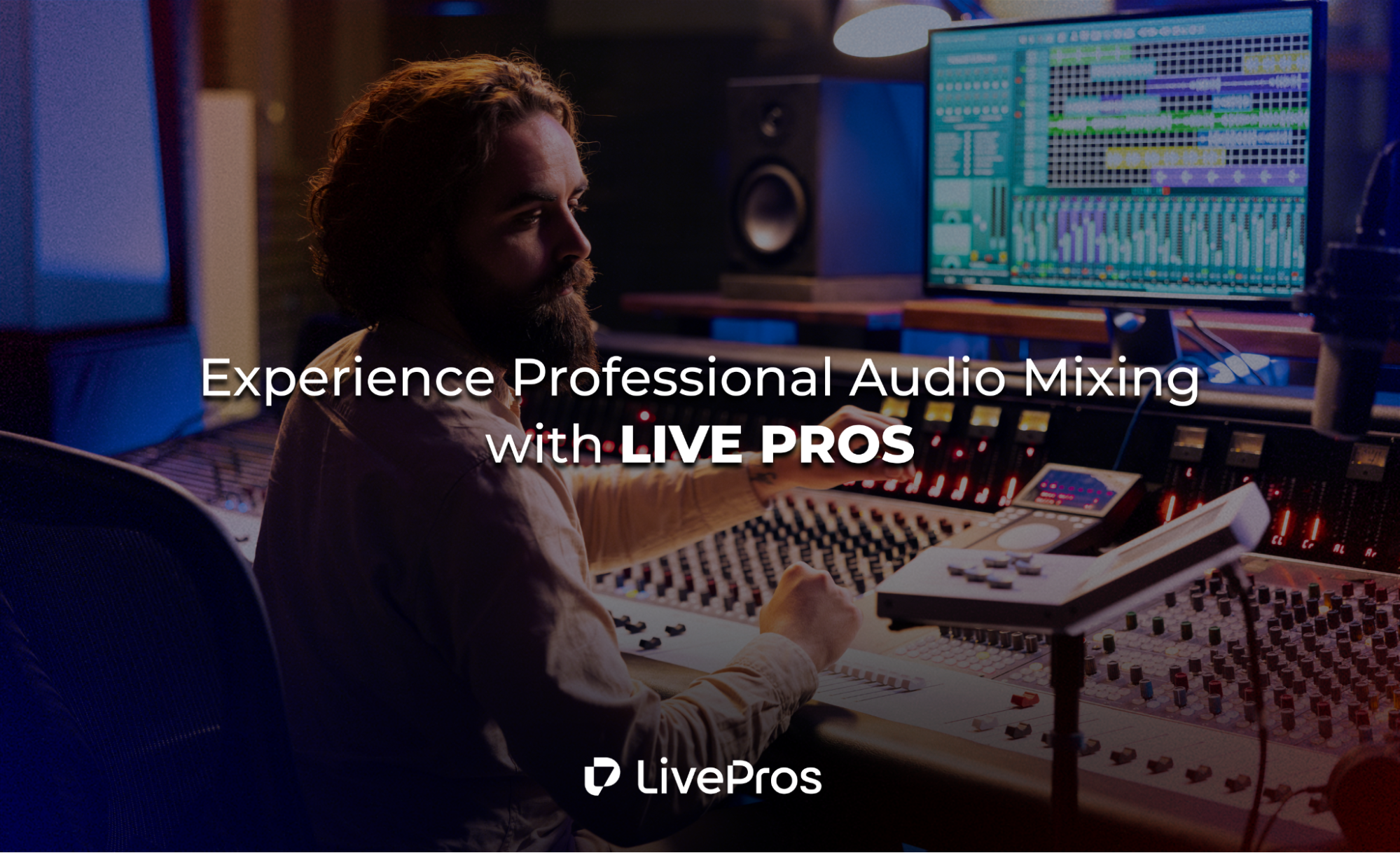
Experience Professional Audio Mixing with LIVE PROS
LIVE PROS delivers professional audio mixing across concerts, corporate productions, theater performances, weddings, and large-scale events throughout Los Angeles.
Our team combines advanced audio mixing tools, premium sound systems, and proven professional mixing techniques to ensure every production sounds clear, balanced, and reliable.
From live performances and touring productions to studio mixing and hybrid events, we engineer sound environments that perform under real-world conditions.